April 2026
Neural Rate-Adaptive LDPC Decoding for the Slepian-Wolf Problem — Journal Accepted
Can one AI model decode all LDPCA rates?
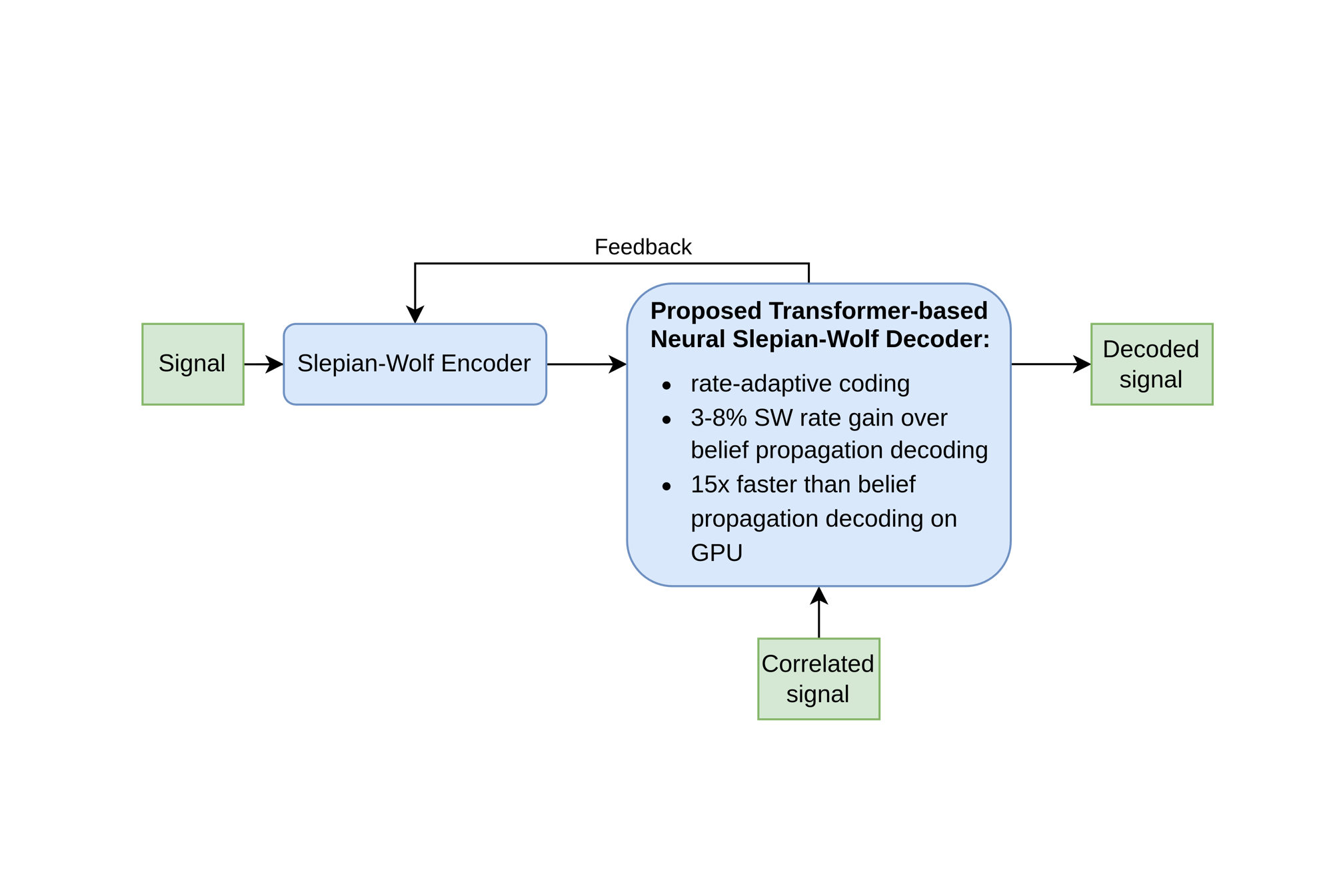
If you’re working on learned compression, neural distributed source coding, or learned channel coding, this might be of interest. At Vrije Universiteit Brussel, ETRO VUB, and imec, in the context of the European Research Council (ERC) Project #IONIAN and the Research Foundation Flanders - FWO PhD Aspirant of Brent De Weerdt, we designed a rate-adaptive neural Slepian–Wolf decoder based on a single multi-rate Transformer. The motivation is simple: in real distributed systems, correlation changes — so fixed-rate Slepian-Wolf coding leaves performance on the table.
We achieved:
- Up to 11% better compression than belief propagation for binary Slepian–Wolf coding
- Up to 15× faster decoding than belief propagation on GPU
- Integration into Wyner–Ziv designs for a distributed stereo image coding pipeline with 9–19% rate reduction at low rates
📄 Paper: lnkd.in/exV6scGa
🧪 Code: lnkd.in/e2QvcCvg
#SignalProcessing #DistributedSourceCoding #SlepianWolf #WynerZiv #LDPC #NeuralDecoding #Transformers #Compression #EdgeAI #VUB #ETRO #imec #ERC #FWO #IONIAN #OpenScience